


Martial arts master was Hollywood’s first Asian American leading man
SEATTLE, Feb. 18, 2026 /PRNewswire/ — The U.S. Postal Service honors and celebrates the life of Chinese American martial artist, actor and filmmaker Bruce Lee with a new stamp featuring an eye-popping image of his iconic flying kick. The stamp was dedicated at a ceremony today at the Nippon Kan Theater in Seattle.
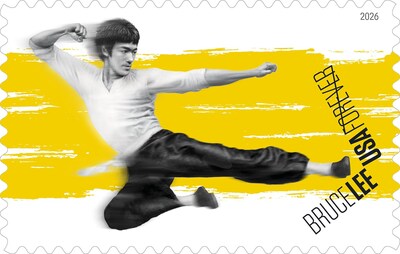
“He was mesmerizing to watch. Unlike the theatrical, acrobatic kung fu that came before, Lee’s movements were economical, explosive and real,” said Ben Kuo, USPS senior vice president of facilities and infrastructure who spoke at the event. “Bruce Lee has earned this special tribute because he wasn’t just an action film star who could fight — he was a philosopher who could think and a teacher who inspired millions.”
Joining Kuo for the ceremony were Lee’s daughter, Shannon Lee; Sue Ann Kay, a former student and friend of Lee; and journalist Jeff Chang. Mimi Gan, an officer of the board of trustees for the Wing Luke Museum, was master of ceremonies, Genelia Lai performed the national anthem and American Legion Cathay Post 186 served as color guard for the day.
Known as Hollywood’s first Asian American leading man, Bruce Lee was a celebrated box office star in Hong Kong well before he dazzled American moviegoers. Shannon Lee says her father’s life was about breaking through barriers and bringing people together along the way.
“His legacy is one of resilience, self-mastery and flow that resonates and connects people across multiple demographics, which is why this stamp is such a profoundly perfect touchpoint and a true honor, especially at this moment in time,” said Lee, CEO of Bruce Lee Enterprises. “Our family is deeply grateful to the USPS for choosing to recognize Bruce Lee, and we are excited to see his kicks flying all across the country on our mail.”
Lee Jun Fan was born in San Francisco on Nov. 27, 1940, while his father, Lee Hoi Chuen, a singer and actor from Hong Kong, and mother, Grace Ho, were in the United States on an extended tour. Their son, who would have dual citizenship, received not only a Cantonese name but an American one suggested by the midwife who delivered him: Bruce. The family returned to Hong Kong when he was a few months old.
With family connections in the Hong Kong film industry, Bruce Lee began appearing in movies as a child, with his first lead role at age 10. His stage name was Li Xiao Long, or “Lee the Little Dragon,” because he was born in both the hour and year of the Dragon in Chinese astrology. As a teenager, Lee studied the Wing Chun style of Chinese kung fu and became an expert boxer as well as a competitor in cha-cha dancing.
Lee arrived back in the United States in 1959. After earning the equivalent of a high school diploma, he started taking classes at the University of Washington and teaching martial arts on the side.
In 1964, he opened a martial arts school in Oakland, CA, and married Linda Emery. Later that year, he would attend karate competitions and demonstrate the “one-inch punch” technique, which enabled him to strike an opponent at close range with extraordinary force.
Watching in the crowd was celebrity hairstylist and martial arts enthusiast Jay Sebring, who was struck by the combination of Lee’s remarkably chiseled frame, lightning-fast hands and feet, and Zen-like composure. A few months later, when a producer-friend was searching for a Chinese actor, Sebring passed along Lee’s name. This was groundbreaking. In Hollywood, Asian roles usually went to Caucasian actors, with Asian actors rarely given a chance. Producer William Dozier gave Lee a screen test in 1965.
Lee’s first major American role was in the television version of “The Green Hornet,” which aired on ABC from September 1966 to March 1967. He played Kato, the title character’s martial artist partner. After one season, the program was canceled in the United States, but caught on in Hong Kong, where it became known as “The Kato Show.” In the late 1960s and early 1970s, Lee choreographed movie fight scenes and appeared in a few TV series but had no starring roles.
During this time, Lee was also developing his own philosophy and style of martial arts. With “Jeet Kune Do” — which roughly translates as “the way of the intercepting fist” — he pushed aside the rigidity of traditional martial arts for a more free-flowing approach. “When there is freedom from mechanical conditioning, there is simplicity,” he wrote in his posthumously published book “Tao of Jeet Kune Do.”
It would be several more years before Warner Bros. studios produced the first Hollywood movie starring Lee. Released in 1972, “Enter the Dragon” became a worldwide phenomenon. It was also added to the National Film Registry, which honors “culturally, historically or aesthetically” significant motion pictures.
Tragically, Lee did not live to see his opus stun American audiences. On July 20, 1973, a month before the film’s premiere, he lay down for a nap and fell into a coma, dying at age 32 of cerebral edema.
In the following decades, Lee’s legend grew. In 1999, he was included in Time magazine’s list of the Top 100 Most Important People of the Century. In 2012, the U.S. House of Representatives paid tribute to Lee with an official statement calling him “a true catalyst for social change and civil rights” and “a cultural and American icon.” The statement concluded that Lee “remains a beacon of hope and opportunity for future generations in America.”
Antonio Alcalá, an art director for USPS, designed the stamp with Kam Mak’s egg tempera painting on traditional gesso. The black-and-white palette with a brush stroke of yellow references his final movie, “The Game of Death,” which was completed and released after his death. Lee’s name and the words “USA” and “FOREVER” are arranged to appear as if Lee’s flying kick were breaking them in half.
The Bruce Lee stamp is available in panes of 20. As a Forever stamp, it will always be equal in value to the current First-Class Mail 1-ounce price. News of the stamp is being shared with the hashtag #BruceLeeStamp.
Postal Products
Customers may purchase stamps and other philatelic products through The Postal Store at usps.com/shopstamps, by calling 844-737-7826, by mail through USA Philatelic or at Post Office locations nationwide. For officially licensed stamp products, shop the USPS Officially Licensed Collection on Amazon. Additional information on stamps, first-day-of-issue ceremonies and stamp-inspired products can be found at stampsforever.com.
Please Note: The Postal Service generally receives no tax dollars for operating expenses and relies on the sale of postage, products and services to fund its operations.
For USPS media resources, including broadcast-quality video and audio and photo stills, visit the USPS Newsroom. Follow us on X, formerly known as Twitter; Facebook; Instagram; Pinterest; Threads and LinkedIn. Subscribe to the USPS YouTube Channel. For more information about the Postal Service, visit usps.com and facts.usps.com.
National contact: Marti Johnson
martha.s.johnson@usps.gov
usps.com/news
Local contact: Janella D. Herron
janella.d.herron@usps.gov
usps.com/news

 View original content to download multimedia:https://www.prnewswire.com/news-releases/postal-service-celebrates-bruce-lee-302691438.html
SOURCE U.S. Postal Service
 Disclaimer: The above press release comes to you under an arrangement with PR Newswire. We takes no editorial responsibility for the same.